

Introduction
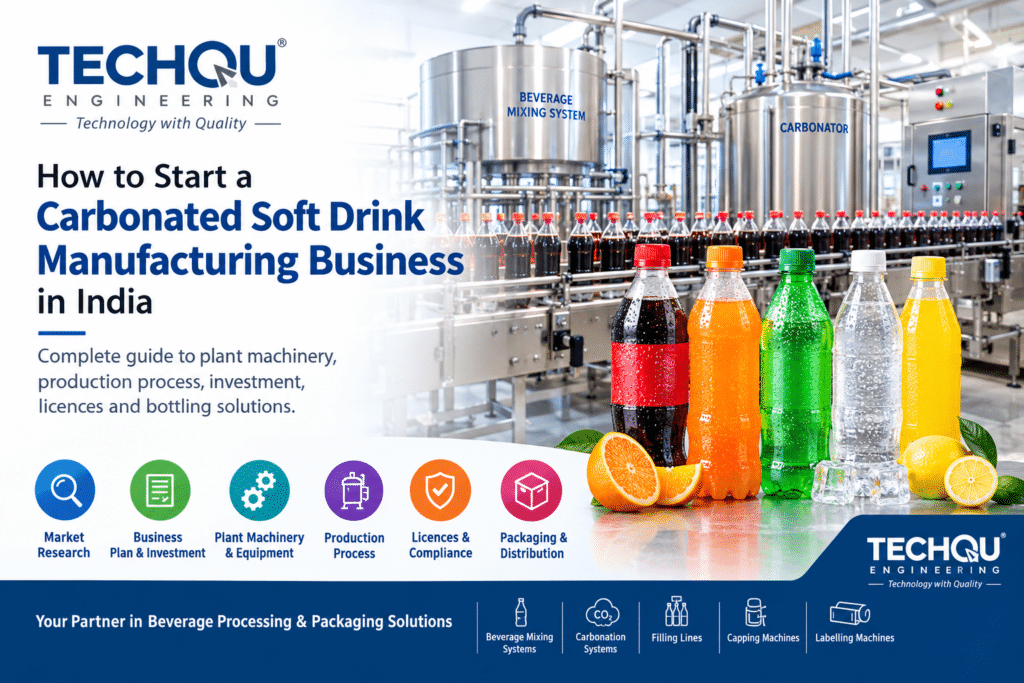
Starting a carbonated soft drink manufacturing business requires more than just a filling machine. You need a suitable production facility, a reliable water treatment system, syrup preparation equipment, a carbonator, a bottling line, quality control procedures and an effective distribution strategy.
In this guide, we explain how to start a carbonated soft drink manufacturing business in India and select the right machinery for your production requirements.
1. Conduct Market Research and Select Your Product Range
Before investing in machinery, identify your target customers, local market demand, competitors and distribution opportunities.
You can consider manufacturing products such as:
- Cola and flavoured carbonated drinks
- Lemon and lime soda
- Orange and other fruit-flavoured carbonated beverages
- Jeera soda and regional carbonated drinks
- Club soda and sparkling water, subject to applicable product standards
- Private-label carbonated beverages for other brands
- 2. Prepare a Business Plan and Estimate Your Investment
- The investment required to establish a CSD manufacturing plant depends on several factors, including production capacity, automation level, building requirements, utilities, packaging type and the number of products you plan to manufacture.Your project budget should account for:
- Factory premises and civil work
- Water treatment and storage systems
- Sugar syrup preparation and filtration equipment
- Beverage mixing and carbonation systems
- Bottle rinsing, filling and capping machines
- Labelling and secondary packaging equipment
- Air compressors, chillers and other utilities
- Quality control and laboratory equipment
- Licences, product development and testing
- Raw materials, packaging inventory, labour and working capital
- 3. Select the Right Carbonated Soft Drink Plant Capacity
- Production capacity is one of the most important decisions when planning your factory.For example, a bottling line may be specified in bottles per minute (BPM). A 24 BPM line and a 120 BPM line have different production capabilities and may require different levels of investment, utilities, manpower and floor space.When selecting capacity, consider:
- Expected daily and monthly sales
- Number of operating hours per shift
- Bottle sizes and packaging formats
- Seasonal fluctuations in demand
- Future production expansion
-
Required automation and labour availability
4. Understand the Carbonated Soft Drink Manufacturing Process
A typical carbonated beverage manufacturing process includes water treatment, syrup preparation, beverage mixing, carbonation, filling, capping, labelling and packaging.
Step 1: Water Treatment
Step 2: Sugar Syrup Preparation
- Step 3: Beverage Mixing
- Step 4: Carbonation
- Step 5: Bottle Rinsing, Filling and Capping
- Step 6: Labelling and Packaging
5. Choose the Right Filling and Packaging Line
Packaging plays an important role in the performance of a carbonated soft drink manufacturing business.
When selecting a filling line, check the following specifications:
- Required capacity in BPM
- Bottle or can size range
- Container material and shape
- Filling heads and capping or sealing arrangement
- Carbonation and filling requirements
- Changeover time between container formats
- Automation level and operator requirements
- Availability of spare parts and technical support
6. Licences and Regulatory Requirements in India
Before starting commercial production, identify the licences, registrations and product-specific compliance requirements applicable to your business.
7. Maintain Quality Control and Food Safety
Consistent quality is essential for building a successful beverage brand.
Your quality control programme should address:
- Raw water quality and treatment performance
- Ingredient measurement and formulation accuracy
- Beverage taste, appearance and consistency
- Brix or soluble solids, as applicable
- Carbonation level and filling performance
- Package integrity and closure quality
- Microbiological safety and hygiene
- Batch traceability and shelf-life validation
8. Plan Your Raw Materials and Operating Costs
Your ongoing operating costs will depend on the beverage formulation, production volume, packaging format and distribution model.
Typical expenses include:
- Sugar or other permitted sweeteners
- Food-grade flavours, colours and approved additives
- Carbon dioxide
- Treated water
- PET bottles, glass bottles or cans
- Caps, labels, cartons and shrink film
- Electricity, water and cooling
- Labour, maintenance and cleaning supplies
- Transportation, warehousing and marketing
9. Build a Strong Brand and Distribution Network
Even a technically efficient manufacturing plant needs a clear route to market.
Start by identifying your target market and the channels most suitable for your beverage, such as local retailers, wholesalers, restaurants, hotels, catering businesses and regional distributors.
Develop a consistent brand identity, attractive packaging and a pricing strategy that considers competition and distribution margins.
10. Why Choose an Integrated CSD Plant Solution?
An integrated carbonated soft drink plant connects beverage preparation, carbonation, filling, capping, labelling and packaging into a coordinated production system.
TechQu Engineering provides processing and packaging equipment solutions for beverage manufacturing projects. Depending on the project scope, the proposed system can include beverage mixing systems, syrup preparation equipment, carbonation systems and compatible filling, capping and labelling machinery.
Conclusion
Starting a carbonated soft drink manufacturing business in India requires careful planning across product development, plant design, machinery selection, regulatory compliance, quality control and distribution.
By selecting the right production capacity and coordinating the syrup preparation, beverage mixing, carbonation and packaging stages, you can establish a manufacturing facility designed around your business goals.
