
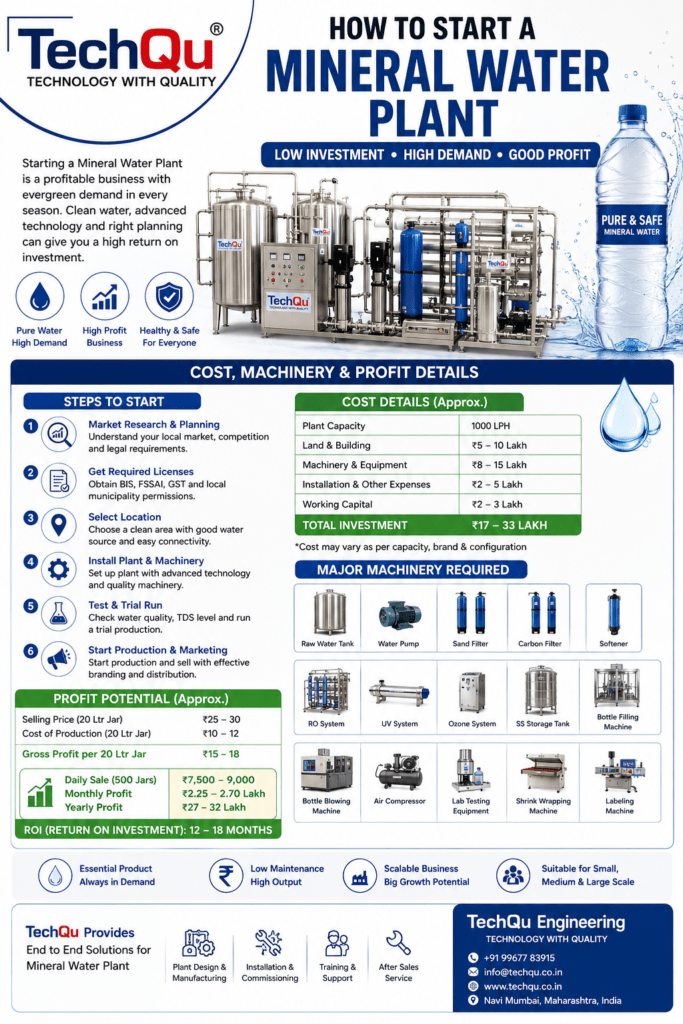
How to start a mineral water plant (cost,machinery and profit)

Starting a mineral water (packaged drinking water) plant requires proper planning, quality equipment, regulatory approvals, and a reliable sales network. Here’s a step-by-step guide:

1: Market Research

Identify your target customers:

  • Retail shops
  • Supermarkets
  • Hotels & Restaurants
  • Offices
  • Schools & Colleges
  • Hospitals
  • Event suppliers
  • Distributors

2: Select Plant Capacity

Capacity Suitable For
250 LPH Small startup
500 LPH Local market
1000 LPH City distribution
2000–5000 LPH Large commercial production

3: Arrange Land & Building

You will typically need:

  • Raw water storage area
  • Water treatment room
  • Filling & packaging room
  • Finished goods storage
  • Laboratory
  • Office
  • Utility room

Recommended area:

  • Small plant: 1,000–1,500 sq. ft.
  • Medium plant: 2,500–4,000 sq. ft.

4: Install the Water Treatment System

The typical process is:

Raw Water → Sand Filter → Activated Carbon Filter → Water Softener (if needed) → Micron Filter → RO System → UV Sterilizer → Ozonation → Pure Water Storage Tank

5: Install Bottling Equipment

A complete bottling line includes:

  • Bottle Rinsing Machine
  • Bottle Filling Machine
  • Bottle Capping Machine
  • Labeling Machine
  • Batch Coding Machine
  • Shrink Wrapping Machine
  • Air Compressor
  • SS Storage Tanks
  • Transfer Pumps

6: Obtain Required Licenses

Before commercial production, you’ll generally need:

  • FSSAI License
  • BIS Certification (IS 14543 for Packaged Drinking Water)
  • GST Registration
  • Factory License (where applicable)
  • Trade License
  • Pollution Control approvals (if applicable)
  • Groundwater permission if using borewell water (where required)

7: Set Up a Quality Control Laboratory

Test regularly for:

  • pH
  • TDS
  • Microbiological contamination
  • Turbidity
  • Hardness
  • Chemical parameters

Maintaining consistent water quality is essential for compliance and customer trust.

8: Branding & Packaging

Develop:

  • Brand name
  • Bottle design
  • Label
  • Cartons
  • Marketing materials

A strong brand can help differentiate your product in a competitive market.

9: Build a Sales Network

Sell through:

  • Dealers
  • Distributors
  • Retail stores
  • Hotels
  • Restaurants
  • Corporate offices
  • E-commerce and local delivery

10: Start Production & Marketing

Focus on:

  • Consistent quality
  • Competitive pricing
  • Fast delivery
  • Good customer service
  • Dealer incentives

Typical Investment

Plant Size Approximate Investment
250 LPH ₹4–8 lakh
500 LPH ₹8–15 lakh
1000 LPH ₹15–30 lakh
2000 LPH ₹30–60 lakh

(Costs vary based on automation, building, utilities, and whether bottles are purchased or manufactured in-house.)

Profit Potential

A well-managed mineral water plant with strong local distribution can typically achieve net profit margins of around 10–25%, depending on production efficiency, packaging costs, and market pricing.

Starting with a 500 LPH or 1000 LPH plant is often a practical option for entrepreneurs because it offers a balance between investment and production capacity while allowing room for future expansion.

Leave a Reply

Your email address will not be published. Required fields are marked *

Home
Email
Call Us
WhatsApp
  • Contact Now
    Contact Form